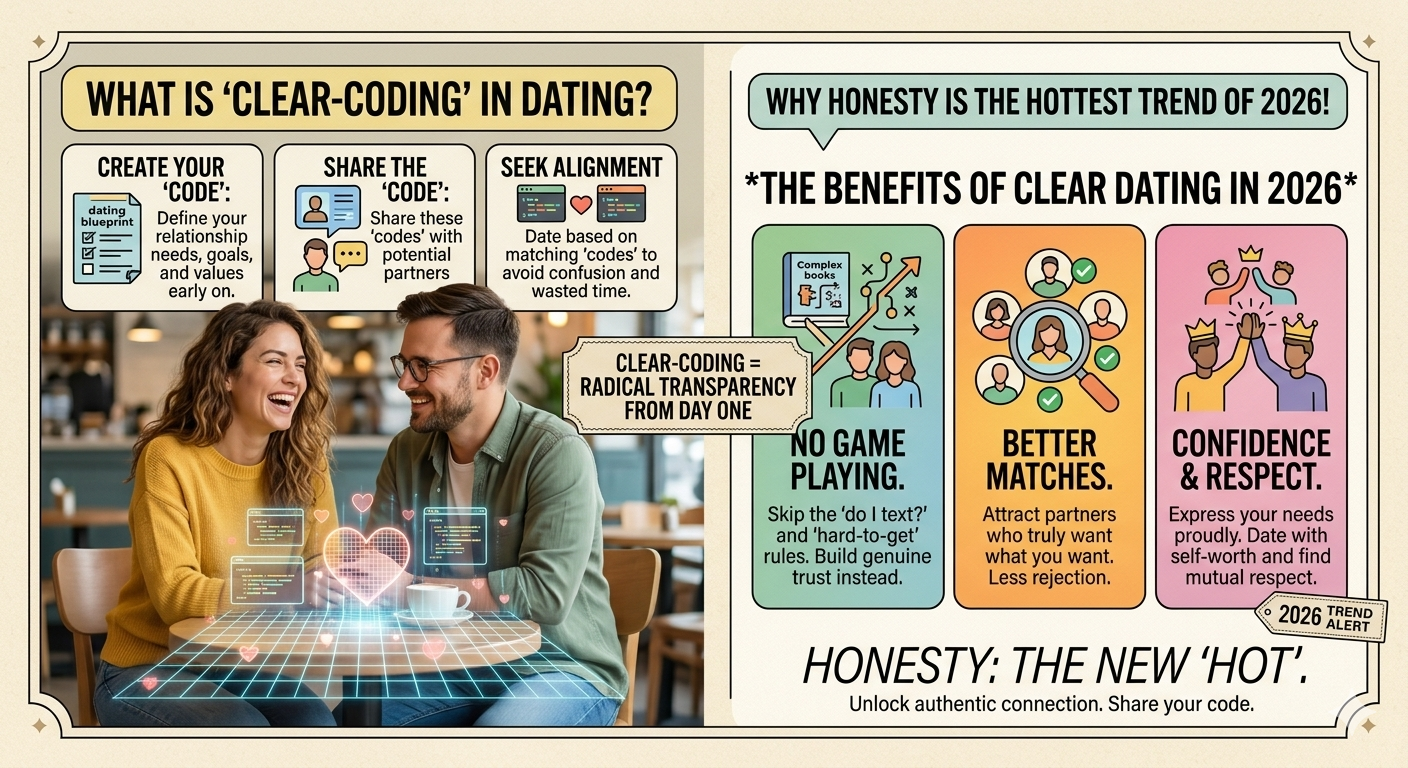
What Does Clear-Coding Actually Mean?
Clear-coding is the practice of stating your intentions, expectations, and emotional availability clearly and early — before ambiguity has a chance to do damage.
It's not a grand declaration. It's not proposing marriage over a first coffee. It's simply removing the fog. Saying "I'm looking for something serious and I'd like to know if we're on the same page" instead of letting weeks pass and hoping it becomes obvious. Saying "I really enjoyed this — I'd like to see you again" instead of the noncommittal "we should do this again sometime" that could mean anything. Saying "I'm not in a place for anything casual right now" instead of going along with something misaligned and hoping feelings catch up.
The term itself borrows from software — in coding, "clear code" is code that's readable, unambiguous, and doesn't require someone to reverse-engineer your intentions to understand what it does. Applied to dating, clear-coding means your communication is readable. What you want is on the surface. You're not making someone decode you.
It sounds simple. In practice, for a generation trained to perform nonchalance and treat vulnerability as a liability, it is genuinely radical.
Why Is This Happening Now?
Clear-coding didn't emerge from nowhere. It's a direct reaction to a decade of dating culture that optimized for everything except honesty.
The rise and hangover of "situationships." The situationship — a romantic connection with no defined terms — became so normalized in the 2020s that it generated its own vocabulary, its own therapy discourse, and eventually its own exhaustion. People got tired of investing emotionally in something with no name and no direction. Clear-coding is, in part, a response to situationship fatigue.
Dating app burnout. When you've swiped through thousands of faces and had hundreds of conversations that went nowhere, the value of someone who simply tells you what they're looking for becomes immediately obvious. Clarity saves time. It also signals maturity in a landscape full of people hedging everything.
A broader cultural shift toward directness. Globally — and noticeably in urban India — younger generations are pushing back against the social expectation to be indirect about desire and intention, particularly in romantic contexts. The data reflects this: a 2025 survey found that 64% of daters across age groups now say emotional honesty is what modern dating needs most. That's not a niche preference. That's a majority.
The mental health conversation. As awareness of anxiety, attachment styles, and emotional labor has mainstreamed, people have become better at articulating why ambiguity is harmful — and more willing to opt out of it. If you know anxious attachment makes prolonged uncertainty genuinely destabilizing for you, tolerating three weeks of mixed signals isn't romantic tension. It's self-harm. Clear-coding is partly a self-protective response.
What Clear-Coding Looks Like in Practice
This is where most explainers on dating trends stay vague. Let's be specific — including what this actually sounds like in an Indian dating context, where directness about romantic intentions has historically been complicated by family expectations, social scripts, and the pressure to not seem "too eager."
On a dating app, before you've even met:
Instead of: keeping your profile deliberately ambiguous so you appeal to the maximum number of people.
Clear-coding looks like: "Looking for something meaningful — not in a rush, but I'm not here to just pass time either." One sentence. No manifesto required. But now anyone who matches with you knows what they're entering.
In early conversations:
Instead of: weeks of "haha" and voice notes that warm up to nothing.
Clear-coding looks like: "I've really enjoyed talking to you — I'd love to meet up in person if you're open to it." Stating interest directly, without dressing it as a casual suggestion.
After a first date:
Instead of: the torturous "had a great time, let's see" text that commits to nothing.
Clear-coding looks like: "I genuinely enjoyed meeting you and I'd like to go on another date. Would you want to?" Yes, this requires vulnerability. Yes, it's worth it — because the alternative is a week of interpretation that exhausts both people.
When you're not feeling it:
Instead of: the slow fade — gradually reducing response time until the conversation dies of neglect.
Clear-coding looks like: "I've really enjoyed getting to know you, but I don't think we're the right fit. I wanted to be honest rather than just go quiet." This takes about thirty seconds to type and saves the other person weeks of wondering.
When family and social context complicate things — which in India, it frequently does — clear-coding doesn't mean ignoring those realities. It means being honest about them. "I'm navigating a lot of family expectations around this and I want to be upfront about that" is clear-coding too. It's not weakness. It's giving someone accurate information so they can make a real decision.
Why Clear-Coding Works Better for Introverts
Here's something the trend pieces won't tell you: clear-coding isn't just a general dating improvement. It's specifically, structurally better for introverts — and introverts are often naturally better at it than they realize.
Introverts tend to be more reflective about what they actually want. They're more comfortable with internal clarity before speaking. They often find sustained ambiguity more draining than extroverts do — which means they have more to gain from eliminating it early.
What introverts are often less comfortable with is the vulnerability of expressing that clarity to someone new. The fear isn't not knowing what you want — it's the exposure of saying it out loud before you know how it'll be received.
This is exactly where reframing helps: stating your intentions clearly isn't putting yourself at risk. It's putting both of you in a position to make a real choice. The person who responds well to your honesty was always worth pursuing. The person who disappears because you were clear was never going to give you what you needed anyway. Clear-coding doesn't increase rejection — it speeds up the sorting process and makes rejection hurt less, because it happens earlier and with more information.
For introverts especially, who hate wasting emotional investment on things that were never going anywhere — clear-coding is one of the most efficient things you can do.
What Clear-Coding Is Not
Because this will get misread: clear-coding is not the same as leading with an overwhelming list of requirements. There's a difference between clarity and a checklist.
"I'm looking for someone who values deep conversation, is open to something serious, and is honest about where they're at" — that's clear-coding. It's honest, warm, and inviting.
"I require someone who is marriage-ready, financially stable, vegetarian, family-oriented, non-drinker, and wants children within two years" delivered before a first coffee — that's not clear-coding. That's a screening interview. The distinction matters.
Clear-coding is about emotional availability and intention, not specifications. It's about removing ambiguity around what you're looking for, not pre-filtering for exactly who that person must be.
It's also not a demand for instant reciprocity. Stating your intentions clearly doesn't obligate the other person to immediately match your level of certainty. They get to respond honestly, which might include "I'm not sure yet" — and that's fine. The point is the honesty, not the outcome.
How to Actually Start Clear-Coding (Without It Feeling Awkward)
The biggest barrier isn't understanding clear-coding. It's executing it without feeling like you're violating some unspoken social rule that says romantic interest must always be wrapped in plausible deniability.
A few things that make it easier:
Start with your profile, not a conversation. The lowest-stakes place to practice clarity is your dating profile. Write what you're actually looking for. Not cryptically, not desperately — just honestly. This filters people before you've invested a single conversation.
Use "I" statements, not requirements. "I'm looking for something meaningful" lands differently than "I want someone who is serious." Same message, very different energy. The first is honest. The second sounds like you're issuing criteria.
Let it be brief. Clear-coding doesn't require a speech. One honest sentence, delivered at the right moment, does more than a paragraph of careful hedging. "I've really liked talking to you — I'm genuinely interested" is complete. It doesn't need more.
Normalize getting clear responses back. If someone clear-codes back at you — if they say "I'm not looking for anything serious" or "I'm still figuring things out" — receive that as a gift, not a rejection. They just saved you a significant amount of time and emotional energy. Thank them internally and move accordingly.
FindFlames and the Clear-Coding Philosophy
Clear-coding works best when the platform you're using supports it — when honesty is treated as an asset rather than a liability, and when the design doesn't reward strategic ambiguity.
Most mainstream dating apps do the opposite. Vagueness keeps people on the app longer. Ambiguity creates more scrolling, more swiping, more time-on-app. The engagement loop depends, at least partly, on nobody being too clear about anything.
FindFlames is built around a different philosophy — that connection happens faster and better when people know what they're entering. Our profiles are designed to surface values, intentions, and what someone is actually looking for — not just their height and their best holiday photo. The matching is built to show you people who are looking for the same kind of connection you are.
Clear-coding isn't a feature we added. It's the principle we built around.
Because the best relationship you'll ever be in started with someone just being honest about wanting to be in it.